The Most Import­ant Meet­ing Is Often the One That Nev­er Happens

Part 2: How a meet­ing ful­fills its purpose

Elena D Cruz

from Dr. Elena D’Cruz
29. September 2026

A meeting room with people in conversation, a symbol for teamwork in the foreground.

In this two-part series, we take a closer look at which decisions actually get made in meetings, why teams tend to avoid hard ones, and how meetings can become what they should be: an opportunity for clarification. If you want to dig deeper, listen to episode 261 of the podcast Think Fast, Talk Smart.

Part 1: Every meeting needs a clear intention – What to settle before the meeting
Part 2: How a meeting fulfills its purpose – What makes the difference in the room

Part 1 looked at how leaders create clarity before a meeting even happens: Is this conversation really necessary, and what should it accomplish? Now we turn to what happens next: which patterns decide whether a meeting actually fulfills its purpose?

Invisible meeting patterns

Some meeting habits are so familiar that we stop noticing them. A team spends twenty minutes debating the color of a flyer, then five minutes on a decision that will shape the next two years. No one plans it that way. It just happens, usually without anyone noticing.

This pattern has a name: bikeshedding. It is what happens when groups spend a disproportionate amount of time and energy on minor details, while the big, complex problems get neglected.

Rebecca Hinds, an organizational behavior researcher and author of Your Best Meeting Ever, sees this exact pattern play out in meetings all the time. It happens because everyone has an opinion on simple questions, and the topic feels safe. Big decisions, on the other hand, are complex and uncomfortable, so it feels easier to put them off.

Psychological safety

In leadership teams, this pattern often shows up exactly where clarity is actually needed: a decision with an uncertain outcome, a conflict between two people, or a strategic choice that might hurt someone in the room. That is precisely where the conversation tends to shift toward the next organizational detail. Not out of carelessness, but because the difficult topic demands real engagement. It requires taking a position, tolerating different points of view, and sitting with uncertainty.

This is where psychological safety plays a decisive role. Difficult topics are more likely to surface where people can disagree, voice uncertainty, or ask uncomfortable questions without fear of consequences. When those voices stay quiet, it often says less about the people involved than about the environment the conversation takes place in.

For leaders, this is a good moment for self-reflection: Where in your own meetings does a disproportionate amount of time go to minor details? And what would likely come up if that time were spent on the actual difficult topic instead? This question is not an invitation to self-criticism. It is an invitation to clarity. Avoidance is a very human response to uncertainty, not a character flaw. But it becomes visible once you know what to look for.

Hinds points to a simple lever here: put the hardest topic first on the agenda, not last. While focus is still fresh, it is easier to engage with the real issue, instead of pushing it toward an end that rarely gets reached anyway.

Who should be in the room

A second pattern is closely connected to the first: the size and composition of the meeting itself. Hinds identifies four dimensions worth rethinking for every recurring meeting, rather than carrying them forward without a second thought:

  • Length: Meetings often run 30 or 60 minutes simply because that is the calendar tool's default setting, not because the topic actually requires that much time.
  • Cadence: A weekly meeting often stays weekly, even when a monthly or quarterly rhythm would be enough.
  • Attendees: More people are often invited than the matter actually requires.
  • Agenda items: Too many items, or items that do not create real progress, weigh the meeting down.

The number of attendees is worth a closer look, especially from a psychological perspective. Jeff Bezos was known at Amazon for his two-pizza rule: a meeting should never have more people than two pizzas can feed. What sounds at first like a practical rule of thumb is actually a question about responsibility. The more people in the room, the more easily responsibility gets spread so thin that no one really feels accountable. Leaders who instead deliberately consider who is truly needed create not just a shorter meeting, but one where the people present actually feel responsible for what gets discussed.

Meetings are more than appointments on a calendar. They show where an organization actually puts its attention. Which topics get time? Which questions get postponed? Which conflicts get addressed, and which get avoided? This is exactly why meetings are worth examining closely. They make visible how priorities are set and how collaboration actually takes shape.

The empty chair

Amazon had another concrete practice for this: during important decision-making meetings, one chair in the room stayed deliberately empty. It represented the customer, the person not present in the room whose perspective was nonetheless affected by every decision. The empty chair is about more than staying close to customers. It is a reminder that every meeting is missing perspectives that should still be considered in the outcome.

This idea extends well beyond the customer. Whose voice is missing from this room, even though the decision affects them? The team member who was not invited today? The colleague from another department whose work depends on this outcome? Or simply your own, less comfortable assessment, the one rarely spoken aloud in the meeting because it might provoke disagreement?

A meeting does not get better just by being shorter or less frequent. It gets better when, by the end, what was unclear at the start has actually been resolved, and when it stays visible what, or who, may have been missing from the room. Perhaps that is the real question worth asking while the next meeting is underway. Is the difficult topic actually being addressed here? And whose voice are we not hearing right now?

Conclusion: What really matters in meetings

Taken together, both parts of this series show that good meetings are not defined by their outcome alone, but by the mindset behind how they are planned and led. Anyone who asks in advance what truly needs to be clarified, and who stays aware in the room of what, or who, might still be missing, turns a simple appointment back into what a meeting should be: a real opportunity for clarification.

Which meeting on your calendar would not pass these questions today?
We would love to hear your thoughts. Join the conversation on LinkedIn.

FAQ: Running successful meetings

Simple, low-stakes topics invite this because everyone has an opinion and the risk is low. Complex, consequential decisions, on the other hand, are uncomfortable because they carry uncertainty and potential for conflict. This shift is a very human avoidance pattern, not a sign of carelessness.

A good starting point is noticing where a disproportionate amount of time goes to smaller, organizational details while the truly difficult topic stays at the margins. Asking what would come up if that time were spent differently often brings clarity on its own.

It symbolizes perspectives missing from the room even though the decision affects them. That could be an absent colleague, a team that bears the consequences, or even your own more uncomfortable assessment, the one rarely spoken aloud. It does not take a big ceremony: often a short, deliberate moment before an important decision is enough to ask who is affected and not in the room.

Er steht sinnbildlich für Perspektiven, die im Raum fehlen, obwohl sie von der Entscheidung betroffen sind. Das kann eine abwesende Kollegin sein, ein Team, das die Konsequenzen trägt, oder auch die eigene unbequemere Einschätzung, die im Gespräch selten ausgesprochen wird. Es braucht dafür keine grosse Zeremonie, oft reicht ein kurzer, bewusster Moment vor einer wichtigen Entscheidung, um sich zu fragen, wer davon betroffen ist und gerade nicht im Raum sitzt.

Work Permits After Brexit

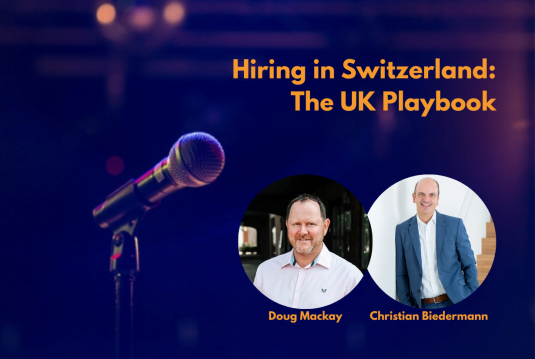
Christian Biedermann and Doug Mackay in conversation: Skills shortages, notice periods, compensation, and Swiss customs. The most important things UK companies need to know before recruiting in Switzerland.